May 27, 2013

  • Best Books of All Time - World Library List

    In 2011, 100 notable writers voted on the 100 greatest novels of all time. I was curious to see how many I had read, and let me say... I'm a little surprised of how many I've never even heard of...


    Finished Reading

    Started but didn't finish

    Never read

    The List

    1) Pride and Prejudice by Jane Austin

    2) 1984 by George Orwell

    3) Hamlet by William Shakespeare

    4) Crime and Punishment by Fyodor Dostoyevsky

    5) The Adventures of Huckleberry Finn by Mark Twain

    6) One Hundred Years of Solitude by Gabriel Garcia Marquez

    7) Wuthering Heights by Emily Bronte

    8) The Odyssey by Homer

    9) Anna Karenina by Leo Tolstoy

    10) Great Expectations by Charles Dickens

    11) Lolita by Vladimir Nabokov

    12) The Old Man and the Sea by Earnest Hemingway

    13) The Brother Karamazov by Fryodor Dostoyevsky

    14) The Stranger by Albert Camus

    15) King Lear by William Shakespeare

    16) Don Quioxote by Miguel de Cerventes Saavaedra

    17) The Hans Christian Anderson Fairy Tales by Hans Christian Anderson

    18) Oedipus Rex by Sophocles

    19) The Iliad by Homer

    20) The Canterbury Tales by Geoffrey Caucer

    21) Moby-Dick by Herman Melville

    22) The Divine Comedy by Dante Alighieri

    23) Madame Boavary by gustave Flaubert

    24) War and Peace by Leo Tolstoy

    25) Othello by William Shakespeare

    26) Mrs. Dalloway by Virginia Wolf

    27) The Trial by Franz Kafka

    28) Ulysses by James Joyce

    29) Pippi Longstocking by Astrid Lindgren

    30) Gulliver's Travels by Jonathan Swift

    31) The Collected Tales by Edgar Allan Poe

    32) The Arabian Nights by Anonymous

    33) Love in the Time of Cholera by Gabriel Garcia Marquez

    34) Things Fall Apart by Chinua Achebe

    35) Blindness #1 by Jose Saramago

    36) The Sound and the Fury by William Faulkner

    37) Invisible Man by Ralph Eillison

    38) Midnight's Children by Salman Rushdie

    39) The Epic of Gilgamesh by Anonymous

    40) Beloved by Toni Morrison

    41) The Death of Ivan Ilych by Leo Tolstoy

    42) The Complete Stories by Franz Kafka

    43) Middlemarch: A Study of Provincial Life by George Eliot

    44) A Doll's House by Henrik Insem

    45) Zorba the Greek by Nikos Kazantzakis

    46) The Idiot by Fyodor Dostoyevsky

    47) Pere Goriot by Honore de Balzac

    48) To the Lighthouse by Virginia Wolf

    49) Medea by Euripides

    50) Selected Stories by Anton Chekhov

    51) Hunger by Knut Hamsun

    52) The Aeneid by Virgil

    53) Faust: First Part by Joahann Wolfgang van Goethe

    54) Leaves of Grass by Walt Witman

    55) The Decameron by Giovanni Boccoccio

    56) Dead Souls by Nikilai Gogol

    57) Swann's Way (In Search of Lost Time, #1) by Marcel Proust

    58) The Magic Mountain by Thomas Mann

    59) Ficciones by Jorge Lius Borgas

    60) The Red and the Black by Stendhal

    61) Buddenbrooks: The Decline of a Family by Thomas Mann

    62) Metamorphoses by Ovid

    63) Memoirs of Hadrian by Marguerite Yourenar

    64) The Life and Opinions of Tristram Shandy, Gentleman by Laurence Sterne

    65) Sons and Lovers by D.H. Lawrence

    66) Mahabharata by Annoynmous

    67) The Complete Essays by Michel de Montaigne

    68) Ramayana by William Buck

    69) The Golden Notebook by Doris Lessing

    70) Demons by Fydor Dostoyevsky

    71) The Tin Drums by Gunter Grass

    72) Season of Migration to the North by Tayeb Salih

    73) Absalom, Absalom! by William Faulkner

    74) Njal's Saga by Anonymous

    75) Sentimental Education by Gustave Flaubert

    76)  Molloy, Malone Dies, The Unnamable: A Trilogy by Samuel Beckett

    77) The Castle by Franz Kafka

    78)  مثنوی معنوی by Rumi

    79) Gargantua an Pantagruel by Francois Rabelais

    80) Independent People by Halldor Laxness

    81) Journey to the End of the Night by Louis-Ferdinand Celine

    82) The Tale of Genji by Murasaki Shikibu

    83) أولاد حارتنا by نجيب محفوظ

    84) The Man Without Qualities by Robert Musil

    85) Jacques the fatalist by Denis Diderot

    86) Nostromo by Joseph Conrad

    87) Romancero Gitano by Fredrico Garcia Lorca

    88) The Book of Job by Anonmyous

    89) The Book of Disquiet by Fernando Pessoa

    90) Diary of a Madman and Other Stories by Lu Xun

    91) Pedro Paramo by Juan Rulfo

    92) Berlin Alexanderplatz Alfred Doblin

    93) Poems of Paul Celan by Paul Celan

    94) The Sound of the Mountain by Yasunari Kawabatoa

    95) History by Elsa Morante

    96) Zeno's Conscience by Italo Svevo

    97) The Recognition of Sakuntala by Kalidasa

    98) Grande Sertao: Veredas by Joao Guimaraes Rosa

    99) The Poems of Leopardi by Giacomo Leopardi

    100) The Orchard: The Bostan of Saadi of Shiraz by Saadi


    How many have you read?


May 24, 2013

  • Day 26

    Day 01 - A picture of yourself with fifteen facts.
    Day 02 - A picture of you and the person you have been close with the longest.
    Day 03 - A picture of the cast from your favorite show.
    Day 04 - A picture of a habit you wish you didn't have..........
    Day 05 - A picture of your favourite memory.
    Day 06 - A picture of a person you'd love to trade places with for a day.
    Day 07 - A picture of your most treasured item.
    Day 08 - A picture that makes you laugh.
    Day 09 - A picture of the person who has gotten you through the most.
    Day 10 - A picture of the person you do the most messed up things with.
    Day 11 - A picture of something you hate.
    Day 12 - A picture of something you love.
    Day 13 - A picture of your favorite band or artist.
    Day 14 - A picture of someone you could never imagine your life without.
    Day 15 - A picture of something you want to do before you die.
    Day 16 - A picture of someone who inspires you.
    Day 17 - A picture of something that has made a huge impact on your life recently.
    Day 18 - A picture of your biggest insecurity.
    Day 19 - A picture of you when you were little.
    Day 20 - A picture of somewhere you'd love to travel.
    Day 21 - A picture of something you wish you could forget.
    Day 22 - A picture of something you wish you were better at.
    Day 23 - A picture of your favorite book.
    Day 24 - A picture of something you wish you could change.
    Day 25 - A picture of your day.
    Day 26 - A picture of something that means a lot to you.
    Day 27 - A picture of yourself and a family member.
    Day 28 - A picture of something you're afraid of.
    Day 29 - A picture that can always make you smile.
    Day 30 - A picture of someone you miss.

    Dallas, Texas


    Dallas was founded in 1841 and was formally incorporated as a city in February 1856. The city's economy is primarily based on banking, commerce, telecommunications, computer technology, energy, healthcare and medical research, transportation and logistics. The city is home to the third largest concentration of Fortune 500 companies in the nation. Located in North Texas and a major city in the American South, Dallas is the main core of the largest inland metropolitan area in the United States that lacks any navigable link to the sea.

    The city's prominence arose from its historical importance as a center for the oil and cotton industries, and its position along numerous railroad lines. With the advent of the interstate highway system in the 1950s and 1960s, Dallas became an east/west and north/south focal point of the interstate system with the convergence of four major interstate highways in the city, along with a fifth interstate loop around the city. Dallas developed a strong industrial and financial sector, and a major inland port, due largely to the presence of Dallas/Fort Worth International Airport, one of the largest and busiest airports in the world.

    In the latest rankings, Dallas was rated as an Alpha world city by the Globalization and World Cities Study Group & Network and is the only city in the South Central region to achieve that status. Dallas is also ranked 14th in world rankings of GDP by the Organization for Economic Co-operation and Development.

    Dallas has a humid subtropical climate, though it is located in a region that also tends to receive warm, dry winds from the north and west in the summer, bringing temperatures well over 100 °F at times and heat-humidity indexes soaring to as high as 117 °F. When only temperature itself is accounted for, the north central Texas region where Dallas is located is one of the hottest in the United States during the summer months, usually trailing only the Mojave Desert basin of Arizona, southern Nevada, and southeastern California.

    Winters in Dallas are generally mild to warm, with normal daytime highs ranging from 55 °F to 70 °F and normal nighttime lows falling in between 30 °F  and 45 °F. A day with clear, sunny skies, a high of 63 °F, and a low of 36 °F would thus be a very typical one during the winter. However, strong cold fronts known as "Blue Northers" sometimes pass through the Dallas region, plummeting nightly lows below 25 °F for up to a few days at a time and keeping daytime highs in a struggle to surpass 40 °F. Snow accumulation is usually seen in the city at least once every winter, and snowfall generally occurs 1–2 days out of the year for an annual average of 1.8 inches. Some areas in the region, however, receive more than that, while other areas receive negligible snowfall or none at all.

    Dallas is home to teams in all four major sports: the Dallas Cowboys (National Football League), Dallas Mavericks (National Basketball Association),Texas Rangers (Major League Baseball), and Dallas Stars (National Hockey League).

    In 2011, Dallas became the first city to host the Super Bowl, the World Series, and the NBA Finals, all within the same 12-month period. Both the Texas Rangers and Dallas Mavericks won successive playoff games to reach the championship in their respective sports, whereas the Cowboys Stadium in Arlington was chosen in advance to host the Super Bowl.

    Nearby Arlington, Texas is the new home to the Dallas Cowboys of the National Football League. Since joining the league as an expansion team in 1960, the Cowboys have enjoyed substantial success, advancing to eight Super Bowls and winning five; according to profootballreference.com, as of the end of the 2009 season they were the winningest active NFL franchise. Known widely as "America's Team", the Dallas Cowboys are financially the most valuable sports 'franchise' in the United States, worth approximately 1.5 billion dollars. They are also the second most valuable sports organization in the world. The Cowboys are only out-valued by Manchester United, who are valued at 1.8 billion dollars. In 2009, the Cowboys relocated to their new 80,000-seat stadium in Arlington, which was the site of Super Bowl XLV. The college Cotton Bowl Classic football game was played at the Cotton Bowl through its 2009 game, but has moved to Cowboys Stadium.

    Dallas is my home. I no longer live there. Soon I'll graduate college, and go to law school - not in Dallas, but Dallas will be my home. It's where I learned everything. That will always mean everything to me.

May 21, 2013

  • Day 25

    Day 01 - A picture of yourself with fifteen facts.
    Day 02 - A picture of you and the person you have been close with the longest.
    Day 03 - A picture of the cast from your favorite show.
    Day 04 - A picture of a habit you wish you didn't have..........
    Day 05 - A picture of your favourite memory.
    Day 06 - A picture of a person you'd love to trade places with for a day.
    Day 07 - A picture of your most treasured item.
    Day 08 - A picture that makes you laugh.
    Day 09 - A picture of the person who has gotten you through the most.
    Day 10 - A picture of the person you do the most messed up things with.
    Day 11 - A picture of something you hate.
    Day 12 - A picture of something you love.
    Day 13 - A picture of your favorite band or artist.
    Day 14 - A picture of someone you could never imagine your life without.
    Day 15 - A picture of something you want to do before you die.
    Day 16 - A picture of someone who inspires you.
    Day 17 - A picture of something that has made a huge impact on your life recently.
    Day 18 - A picture of your biggest insecurity.
    Day 19 - A picture of you when you were little.
    Day 20 - A picture of somewhere you'd love to travel.
    Day 21 - A picture of something you wish you could forget.
    Day 22 - A picture of something you wish you were better at.
    Day 23 - A picture of your favorite book.
    Day 24 - A picture of something you wish you could change.
    Day 25 - A picture of your day.
    Day 26 - A picture of something that means a lot to you.
    Day 27 - A picture of yourself and a family member.
    Day 28 - A picture of something you're afraid of.
    Day 29 - A picture that can always make you smile.
    Day 30 - A picture of someone you miss.

    May 21, 2013


    I'm sitting in an interior hallway, under a Tornado Warning. In DFW, tornadoes are no big deal. We don't take them seriously, but we all know what happened yesterday in Moore, and that's got everyone on edge. After all, my house is only two and a half hours from downtown OKC. I've been in several tornadoes, and quite honestly, I like to watch them. Usually, I sit out on the back porch until the someone yells at me to get inside, or until I start to get freaked out.

    At 11AM today, a Newscast interrupted regular programming and insisted that everyone in my county get inside and stay away from West facing windows. A little less than an hour ago, my phone beeped with a FB alert: "Get indoors and take cover immediately." During tornadoes, my sister likes to hide out in a hall closet - but I don't think that's the best place to take cover. I always sit inside a doorframe in a downstairs interior hallway. So that's where I am, and that's where my sister is. Sitting here, strumming an acoustic guitar, writing on a battery charged laptop, listening to a battery charged weather broadcast, wood, plaster, and some insulation the only thing separating 115lbs of Addy from Meteorological warfare, all I really want is for the walls to stop growling at me.

May 18, 2013

  • For a Teen Drama


    Please! I've just been given a job by an undisclosed production company to write a teen drama. Kind of The Perks of Being a Wallflower meets The Silver Linings Playbook meets Little Miss Sunshine kind of a thing. I'd love all my readers to vote on their top one girl name and top two boy name from this list:

    Arden, Ashling, Brynna, Fallon, Fiona, Freya, Hadley, Jaqualine, Livvy, Margy, Paige, Raiden, Remy, Rhys, Valerie, Zoey

    Andy, Blaine, Brett, Chandler, Clinton, Dustin, Eamon, Hollister, Jakey, Joshy, Oliver, Thomas, Wolf, Zacky, Zander

    And please rec guys. I'd love to have more votes, and you may just see your favorite name on the big screen soon!

April 23, 2013

  • Memories, Stage Moms, and Abby Lee Miller

    My roommate has got me hooked on some Lifetime television show called "Dance Moms". Now, I was a dancer in high school and to be quite honest - Abby Lee Miller is a carbon copy of my competition instructor. The "tough love" method did nothing but help me. While I chose to pursue a career in law rather than dancing, I can still hear my dance teacher's voice in my head at times. She would always (rudely) say things like: "Don't wear orange because it makes you look like an orangutan." "Never use a curling iron. You're too old to play Annie."

    As far as Stage Mom's go, last night I saw an episode that caused some serious PTSD.

April 22, 2013

  • Day 24

    I know! I know! I haven't written in months! - and it sure has been a long few months on top of that. Just a few days after I made my last post, I managed to re-injure myself by slipping and falling in the (dorm) shower. Because of such, I had to spend a week in the Sherman hospital. When I returned to school, it was time for midterms. They were intense, but I was able to pull out an A, A, A-, and A+. Thank God.

    I wasn't sure where to re-start my whole blogging thing, but I remembered that I never finished my 30days agenda that I started last summer - so here we are, picking up at day 24!

    Day 01- A picture of yourself with fifteen facts.
    Day 02 - A picture of you and the person you have been close with the longest.
    Day 03 - A picture of the cast from your favorite show.
    Day 04 - A picture of a habit you wish you didn't have..........
    Day 05 - A picture of your favourite memory.
    Day 06 - A picture of a person you'd love to trade places with for a day.
    Day 07 - A picture of your most treasured item.
    Day 08 - A picture that makes you laugh.
    Day 09 - A picture of the person who has gotten you through the most.
    Day 10 - A picture of the person you do the most messed up things with.
    Day 11 - A picture of something you hate.
    Day 12 - A picture of something you love.
    Day 13 - A picture of your favorite band or artist.
    Day 14 - A picture of someone you could never imagine your life without.
    Day 15 - A picture of something you want to do before you die.
    Day 16 - A picture of someone who inspires you.
    Day 17 - A picture of something that has made a huge impact on your life recently.
    Day 18 - A picture of your biggest insecurity.
    Day 19 - A picture of you when you were little.
    Day 20 - A picture of somewhere you'd love to travel.
    Day 21 - A picture of something you wish you could forget.
    Day 22 - A picture of something you wish you were better at.
    Day 23 - A picture of your favorite book.
    Day 24 - A picture of something you wish you could change.
    Day 25 - A picture of your day.
    Day 26 - A picture of something that means a lot to you.
    Day 27 - A picture of yourself and a family member.
    Day 28 - A picture of something you're afraid of.
    Day 29 - A picture that can always make you smile.
    Day 30 - A picture of someone you miss.

    Car Crash

    Back in November I was in a serious car crash. Don't be fooled. This photo is deceiving. The damage was a lot worse than the picture portrays. Luckily my car is engineered with a roll-cage, otherwise; I'd probably be dead.

    I don't remember exactly what happened; I know I was driving a white Volvo s40 with beige leather interior. I know that I was wearing my seatbelt, and strangely enough; I know that "Tales of Wyoming" by Annie Proulx was in the passenger seat instead of in my backpack. I know that it was the weekend. Either Saturday or Sunday, because I know I didn't have class that day. I know I was driving home because my stomach was hurting and I thought I would just have my dad look at it, instead of paying for another doctor to poke my belly and write a script for Cephalosporin.

    The first real, actual, memory I have is waking up in the hospital, looking to my right, and seeing Sally Kate half-asleep on a lumpy looking couch. Then, I tried to say something to her, choked, and realized I was on a breathing tube. Then, I looked straight forward, saw my step-mom, who saw that I was awake. She hit the call button, and the doctor came in to take out the breathing tube. 

    I stayed in that unit for about three weeks before I was moved to Rehab. Unfortunately, I will most likely never be in the same physical condition as before the crash, and before I developed my rare spleen condition. But, if there is one awesome thing that came out of my crash. It's this:

    Red is always hotter!

February 19, 2013

  • Best 'Required Readings'

    If there's one thing I don't miss about high school, it's the required readings, quarterly book reports, la la la. In college, they don't make us read non-sense - which is pretty cool. Along the way to AC, I did happen to read some things that didn't make me want to bash in my own skull. My favorite required readings:


    Five.

    Of Mice and Men

    Written by: John Stienbeck
    First Published: 1937
    Required: 9th Grade

    Two migrant field workers in California on their plantation during the Great Depression—George Milton, an intelligent but uneducated man, and Lennie Small, a man of large stature and great strength but limited mental abilities—are on their way to another part of California in Soledad. They hope to one day attain their shared dream of settling down on their own piece of land. Lennie's part of the dream is merely to tend to (and touch) soft rabbits on the farm. This dream is one of Lennie's favorite stories, which George constantly retells. They are fleeing from their previous employment in Weed, California, where they were run out of town after Lennie's love of stroking soft things resulted in an accusation of attempted rape when he touched a young woman's dress, and would not let go. It soon becomes clear that the two are close friends and George is Lennie's protector. The theme of friendship is constant throughout the story.

    At the ranch, the situation appears to be menacing and dangerous, especially when the pair are confronted by Curley—the boss's small-statured aggressive son with an inferiority complex who dislikes larger men—leaving the gentle giant Lennie potentially vulnerable. Curley's flirtatious and provocative wife, to whom Lennie is instantly attracted, poses a problem as well. In sharp contrast to these two characters, the pair also meets Slim, the kind, intelligent and intuitive jerkline skinner whose dog has recently had a litter of puppies. Slim gives a puppy to Lennie.

    In spite of the potential problems on the ranch, their dream leaps towards reality when Candy, the aged, one-handed ranch hand, offers to pitch in with George and Lennie so that they can buy a farm at the end of the month in return for permission to live with them on it. The trio are ecstatic, but their joy is overshadowed when Curley attacks Lennie. In response, Lennie, urged on by George, catches Curley's fist and crushes it, reminding the group there are still obstacles to overcome before their goal is reached.

    Nevertheless, George feels more relaxed, since the dream seems just within their grasp, to the extent that he even leaves Lennie behind on the ranch while he goes into town with the other ranch hands. Lennie wanders into the stable, and chats with Crooks, the bitter, yet educated stable buck, who is isolated from the other workers because he is black. Candy finds them and they discuss their plans for the farm with Crooks, who cannot resist asking them if he can hoe a garden patch on the farm, despite scorning the possibility of achieving the dream. Curley's wife makes another appearance and flirts with the men, especially Lennie. However, her spiteful side is shown when she belittles them and is especially harsh towards Crooks because of his race, threatening to have him lynched.

    Lennie accidentally kills his puppy while stroking it. Curley's wife enters the barn and tries to speak to Lennie, admitting that she is lonely and how her dreams of becoming a movie star are crushed, revealing the reason she flirts with the ranch hands. After finding out that Lennie loves stroking soft things, she offers to let him stroke her hair, but panics and begins to scream when she feels his strength. Lennie becomes frightened, and in the scuffle, unintentionally breaks her neck. When the other ranch hands find the corpse, George unhappily realizes that their dream is at an end. George hurries away to find Lennie, hoping he will be at the meeting place they designated at the start of the novel in case Lennie got into trouble, knowing that there is only one thing he can do to save Lennie from the painful death that Curley's lynch mob intends to deliver.

    George meets Lennie at the designated place, the same spot they camped in the night before they came to the ranch. The two sit together and George retells the beloved story of the bright future together that they will have, knowing it is something they will never share. He then shoots Lennie in the back of the head, so that his death will be painless and happy. Curley, Slim, and Carlson find George seconds after the shooting. Only Slim realizes that George killed Lennie out of love, and gently and consolingly leads him away, while Curley and Carlson look on, unable to comprehend the subdued mood of the two men.


    Four.

    The Outsiders

    Written by: S.E. Hinton

    First Published: April 24th, 1967

    Required: 7th Grade

    Ponyboy, a member of the Greasers gang, is leaving a movie theater when a group of Socs jumps him. His older brothers Darry and Sodapop save him. The next night, Ponyboy and his friends Dally and Johnny meet Cherry Valance and Marcia at a drive-in movie theatre. Ponyboy realizes that Cherry is nothing like the Socs he has met before. The Greasers walk Cherry and Marcia home, and Socs Bob Sheldon and Randy Adderson see them and think the boys are trying to pick up their girlfriends. Cherry and Marcia prevent a fight by leaving with Bob and Randy willingly. When Ponyboy comes home very late, Darry gets angry and hits him. Ponyboy runs away and meets up with Johnny. As they wander around the neighborhood, Bob, Randy, and three other drunk Socs confront them. After a Soc nearly drowns Ponyboy in a fountain, a terrified Johnny stabs Bob, accidentally killing him. Ponyboy and Johnny find Dally, who gives them money and a loaded gun and tells them to hide in an abandoned church. They stay there for a few days, during which time Ponyboy reads Gone with the Wind to Johnny and recites the poem "Nothing Gold Can Stay" byRobert Frost.

    When Dally comes to get them, he reveals that the fights between the rival groups have exploded in intensity since Bob's death. Johnny decides to turn himself in, but the boys then notice that the church has caught on fire and several children are trapped inside. When Johnny and Ponyboy rush to rescue them, burning timber falls on Johnny, breaking his back. Dally rescues Johnny. Ponyboy is relatively unscathed and spends a short time in the hospital. When his brothers arrive to see him, Darry breaks down and cries. Ponyboy then realizes that Darry cares about him, and is only hard on Ponyboy because he wants him to have a good future.

    Two-Bit informs Ponyboy that he and Johnny have been declared heroes for rescuing the kids, but Johnny will be charged with manslaughter for Bob's death. He also says that the Greasers and Socs have agreed to settle their turf war with a major rumble. The Greasers win the fight. After the rumble, Dally and Ponyboy visit Johnny and see him die. An overcome Dally rushes out of the hospital and robs a store. When he points is empty gun at the police, they shoot and kill him. Ponyboy faints and stays sick and delirious for nearly a week. While recovering, he tries to convince himself that Johnny is not dead and that he is the one who killed Bob.

    When Ponyboy goes back to school, his grades drop. Although he is failing English, his teacher says he will pass him if he writes a decent theme. In the copy of Gone with the Wind that Johnny gave him before dying, Ponyboy finds a note from Johnny describing how he will die proudly after saving the kids from the fire. Johnny also urges Ponyboy to "stay gold". Ponyboy decides to write his English assignment about the recent events, and begins: "When I stepped out into the bright sunlight from the darkness of the movie house, I had only two things on my mind: Paul Newma nand a ride home..."


    Three.

    A Clockwork Orange
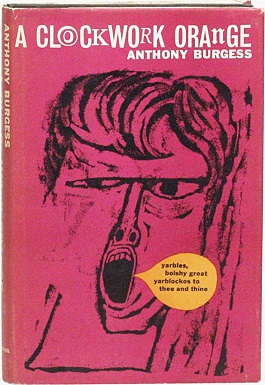
    Written by: Anthony Burges

    First Published: 1962

    Required: 12th Grade

    Alex, a teenager living in near-future England, leads his gang on nightly orgies of opportunistic, random "ultra-violence." Alex's friends ("droogs" in the novel's Anglo-Russian slang, Nadsat) are: Dim, a slow-witted bruiser who is the gang's muscle; Georgie, an ambitious second-in-command; and Pete, who mostly plays along as the droogs indulge their taste for ultra-violence. Characterised as a sociopath and a hardened juvenile delinquent, Alex is also intelligent and quick-witted, with sophisticated taste in music, being particularly fond of Beethoven, or "Lovely Ludwig Van."

    The novel begins with the droogs sitting in their favorite hangout (the Korova Milk Bar), drinking milk-drug cocktails, called "milk-plus", to hype themselves for the night's mayhem. They assault a scholar walking home from the public library, rob a store, leaving the owner and his wife bloodied and unconscious, stomp a panhandling derelict, then scuffle with a rival gang. Joyriding through the countryside in a stolen car, they break into an isolated cottage and maul the young couple living there, beating the husband and raping his wife. In a metafictional touch, the husband is a writer working on a manuscript called "A Clockwork Orange," and Alex contemptuously reads out a paragraph that states the novel's main theme before shredding the manuscript. Back at the milk bar, Alex punishes Dim for some crude behaviour, and strains within the gang become apparent. At home in his dreary flat, Alex plays classical music at top volume while fantasizing of even more orgiastic violence.

    Alex skips school the next day. Following an unexpected visit from P. R. Deltoid, his "post-corrective advisor," Alex meets a pair of ten-year-old girls and takes them back to his parents' flat, where he serves them scotch and soda, injects himself with hard drugs, and then rapes them. That evening, Alex finds his droogs in a mutinous mood. Georgie challenges Alex for leadership of the gang, demanding that they pull a "man-sized" job. Alex quells the rebellion by slashing Dim's hand and fighting with Georgie, then in a show of generosity takes them to a bar, where Alex insists on following through on Georgie's idea to burgle the home of a wealthy old woman. The break-in starts as farce and ends in tragic pathos, as Alex's attack kills the elderly woman. His escape is blocked by Dim, who attacks Alex, leaving him incapacitated on the front step as the police arrive.

    Sentenced to prison for murder, Alex gets a job at the Wing chapel playing religious music on the stereo before and after services as well as during the singing of hymns. The prison chaplain mistakes Alex's Bible studies for stirrings of faith (Alex is actually reading Scripture for the violent passages). After Alex's fellow cellmates blame him for beating a troublesome cellmate to death, he agrees to undergo an experimental behaviour-modification treatment called the Ludovico Technique. The technique is a form of aversion therapy in which Alex receives an injection that makes him feel sick while watching graphically violent films, eventually conditioning him to suffer crippling bouts of nausea at the mere thought of violence. As an unintended consequence, the soundtrack to one of the films — Beethoven's Ninth Symphony — renders Alex unable to listen to his beloved classical music.

    The effectiveness of the technique is demonstrated to a group of VIPs, who watch as Alex collapses before a walloping bully, and abases himself before a scantily-clad young woman whose presence has aroused his predatory sexual inclinations. Though the prison chaplain accuses the state of stripping Alex of free will, the government officials on the scene are pleased with the results and Alex is released into society.

    Since his parents are now renting his room to a lodger, Alex wanders the streets and enters a public library where he hopes to learn a painless way to commit suicide. There, he accidentally encounters the old scholar he assaulted earlier in the book, who, keen on revenge, beats Alex with the help of his friends. The policemen who come to Alex's rescue turn out to be none other than Dim and former gang rival Billyboy. The two policemen take Alex outside of town and beat him up. Dazed and bloodied, Alex collapses at the door of an isolated cottage, realizing too late that it is the house he and his droogs invaded in the first half of the story. Because the gang wore masks during the assault, the writer does not recognise Alex. The writer, whose name is revealed as F. Alexander, shelters Alex and questions him about the conditioning. During this sequence, it is revealed that Mrs. Alexander died from the injuries inflicted during the gang-rape, and her husband has decided to continue living "where her fragrant memory persists" despite the horrid memories. Alexander, a critic of the government, hopes to use Alex as a symbol of state brutality and thereby prevent the incumbent government from being re-elected. Eventually, he begins to realise Alex's role in the happenings of the night two years ago. One of Alexander's radical associates manages to extract a confession from Alex after removing him from F. Alexander's home and then locks him in a flatblock near his former home. Alex is then subjected to a relentless barrage of classical music, prompting him to attempt suicide by leaping from a high window.

    Alex wakes up in hospital, where he is courted by government officials anxious to counter the bad publicity created by his suicide attempt. With Alexander safely packed off to a mental institution, Alex is offered a well-paying job if he agrees to side with the government. As photographers snap pictures, Alex daydreams of orgiastic violence and realises the Ludovico conditioning has been reversed: "I was cured, all right".

    In the final chapter, Alex has a new trio of droogs, but he finds he is beginning to outgrow his taste for violence. A chance encounter with Pete, now married and settled down, inspires Alex to seek a wife and family of his own. He contemplates the likelihood of his future son being a delinquent as he was, a prospect Alex views fatalistically.


    Two.

    The Rime of the Ancient Mariner

    Written by: Samuel Taylor Coolridge

    First Published: 1798

    Required: 10th Grade

    The Rime of the Ancient Mariner relates the experiences of a sailor who has returned from a long sea voyage. The Mariner stops a man who is on the way to a wedding ceremony and begins to narrate a story. The Wedding-Guest's reaction turns from bemusement to impatience and fear to fascination as the Mariner's story progresses, as can be seen in the language style: for example, Coleridge uses narrative techniques such as personification and repetition to create either a sense of danger, of the supernatural or of serenity, depending on the mood of each of the different parts of the poem.

    The Mariner's tale begins with his ship departing on its journey. Despite initial good fortune, the ship is driven south off course by a storm and eventually reaches Antarctica. An albatross appears and leads them out of the Antarctic but, even as the albatross is praised by the ship's crew, the Mariner shoots the bird ("with my cross-bow / I shot the albatross"). The crew is angry with the Mariner, believing the albatross brought the south wind that led them out of the Antarctic. However, the sailors change their minds when the weather becomes warmer and the mist disappears ("'Twas right, said they, such birds to slay / that bring the fog and mist"). However, they made a grave mistake in supporting this crime as it arouses the wrath of spirits who then pursue the ship "from the land of mist and snow"; the south wind that had initially led them from the land of ice now sends the ship into uncharted waters, where it is becalmed.

    Day after day, day after day,
    We stuck, nor breath nor motion;
    As idle as a painted ship
    Upon a painted ocean.
    Water, water, every where,
    And all the boards did shrink;
    Water, water, every where,
    Nor any drop to drink.
    Here, however, the sailors change their minds again and blame the Mariner for the torment of their thirst. In anger, the crew forces the Mariner to wear the dead albatross about his neck, perhaps to illustrate the burden he must suffer from killing it, or perhaps as a sign of regret ("Ah! Well a-day! What evil looks / Had I from old and young! / Instead of the cross, the albatross / About my neck was hung"). Eventually, the ship encounters a ghostly vessel. On board are Death (a skeleton) and the "Night-mare Life-in-Death" (a deathly-pale woman), who are playing dice for the souls of the crew. With a roll of the dice, Death wins the lives of the crew members and Life-in-Death the life of the Mariner, a prize she considers more valuable. Her name is a clue as to the Mariner's fate; he will endure a fate worse than death as punishment for his killing of the albatross.

    One by one, all of the crew members die, but the Mariner lives on, seeing for seven days and nights the curse in the eyes of the crew's corpses, whose last expressions remain upon their faces. Eventually, the Mariner's curse is temporarily lifted when he sees sea creatures swimming in the water. Despite his cursing them as "slimy things" earlier in the poem ("Yea, slimy things did crawl with legs / upon the slimy sea"), he suddenly sees their true beauty and blesses them ("a spring of love gush'd from my heart and I bless'd them unaware"); suddenly, as he manages to pray, the albatross falls from his neck and his guilt is partially expiated. The bodies of the crew, possessed by good spirits, rise again and steer the ship back home, where it sinks in a whirlpool, leaving only the Mariner behind. A hermit on the mainland had seen the approaching ship and had come to meet it with a pilot and the pilot's boy in a boat. When they pull him from the water, they think he is dead, but when he opens his mouth, the pilot has a fit. The hermit prays, and the Mariner picks up the oars to row. The pilot's boy goes crazy and laughs, thinking the Mariner is the devil, and says, "The Devil knows how to row." As penance for shooting the albatross, the Mariner, driven by guilt, is forced to wander the earth, tell his story, and teach a lesson to those he meets:

    He prayeth best, who loveth best
    All things both great and small;
    For the dear God who loveth us,
    He made and loveth all.

    After relating the story, the Mariner leaves, and the Wedding Guest returns home, and wakes the next morning "a sadder and a wiser man".


    One.

    The Giver

    Written by: Louis Lowry

    First Published:1993

    Required: 7th Grade


    Jonas, like the other Elevens (other children of the age Eleven), is apprehensive about the upcoming Ceremony of Twelve when he and his peers will be given the jobs they will hold for the rest of their adult lives in their immaculately-organized, tightly-run society known only as the "Community." In the Community, eccentricities in behavior, appearance, or personality are strongly opposed — even outlawed. However, the rules appear to be readily accepted by all, including Jonas. So it is without real protest that he initially accepts his selection as the Receiver of Memory, the keeper of all ancient memories, a job he is told will be filled with pain and the training for which will isolate him from his family and friends forever.


    Yet, under the guidance of the present Receiver, who is a surprisingly kind man, a man who has the same rare, pale eyes as Jonas, the boy absorbs memories that induce for the very first time feelings of true happiness and love. Also, for the first time, Jonas knows what it is to see colors, to feel sunshine or see a rainbow, and to experience snow and the thrill of riding a sled down a hill. But then he is given the painful memories: the wars, the pain, death, loneliness, starvation. These are memories of the Community's deep past. Jonas learns that the Community engineered a society of sameness to protect its people against this past, yet he begins to understand the tremendous loss he and his people have endured by giving their memories away and becoming "sameness".


    Jonas aches with this new-found wisdom and his desire for a life Elsewhere blossoms. But the final blow for Jonas comes when the Receiver, who now calls himself "The Giver," makes him to watch a present-day tape of his own father, a seemingly kind and loving man, "releasing" a baby twin by giving him a lethal injection. Like any other "aberration" from sameness, identical twins are against the rules, so the smaller of the two is dispatched like garbage, without the one who conducted the release understanding the true meaning of the action. Together, Jonas and the Giver come to the understanding that the time for change is now, that the Community has lost its way and must have its memories returned. The only way to make this happen is if Jonas leaves the Community, at which time the memories he has been given will flood back into the people. Jonas wants the Giver to escape with him, but the Giver insists that he will be needed to help the people manage the memories, or they will destroy themselves. The Giver also wants to remain behind so that when his work is done, he can be with the child he surprisingly refers to as his "daughter": Rosemary, a girl with pale eyes who ten years earlier had failed in her training to become the new Receiver of Memories and who had asked to be released (she became too overwhelmed with the memories of pain).


    The Giver devises a plot in which Jonas will escape to Elsewhere and the Giver will make it appear as if Jonas drowned in the river so that the search for him will be limited. In the meantime, the Giver will give Jonas memories of strength and courage to sustain him and save up his meals as Jonas' food supply for his journey.


    However, their plan is changed when Jonas learns one night that the baby, Gabriel, a "newchild" who has been staying with his family unit because of his failure to thrive "correctly" in the Nurturing Center, will be "released" the following morning. Jonas has become connected to this child — coincidentally, the baby also has the same, rare pale eyes as both Jonas and the Giver, and had been absorbing the memories Jonas received by back rubs each night — and now that Jonas knows the true meaning of "release," he has no choice but to escape as planned but with Gabriel. And so without the memories of strength and courage promised, and without even a goodbye to the Giver, Jonas steals his father's bike and leaves with the baby to find Elsewhere, an unknown land that exists somewhere beyond the boundaries of the Communities, a place where nobody he knows has ever gone. Their escape ride is fraught with dangers of cold and hunger, and the two are near death from cold and starvation when they reach the border of what Jonas believes must be Elsewhere, and using his ability to "see beyond," a gift that he does not quite understand, he knows there is a sled waiting for him when he gets to the top of the hill. There is indeed, and he and Gabriel ride the sled down the snowy hill toward a house filled with colored lights and warmth and love and a Christmas tree, and for the first time he hears something he knows must be music. The book ends abruptly and mysteriously here with these final two sentences: "Behind him, across vast distances of space and time, from the place he had left, he thought he heard music too. But perhaps it was only an echo."


    There you have it. The five best things PISD made me read as a child. The Giver remains to be my favorite book of all time.

February 17, 2013

  • My Annual Week in Advance Oscar Thoughts

    Ohhhh, the Academy Awards are just a week away, and that means it's time for my annual Winner Opinions - not predictions, those I post the day before. So, be looking out for my predictions this Saturday! This morning, I'm here to list who I want and who I feel deserves to win based on Interpretation of a Story/Character and Realism (which are the only two things this little movie buff cares about).

    Best Adapted Screenplay

    "Lincoln" Tony Kushner

    "Argo" Chris Thomas

    "Beasts of the Southern Wild" Lucy Alibar and Benh Zeitin

    "Life of Pi" David Magee

    "The Silver Linings Playbook" David O. Russell


    Best Original Screenplay

    "Django Unchained" Quentin Taratino

    "Amour" Michael Haneke

    "Flight" John Gatins

    "Moonrise Kingdom" Wes Anderson and Roman Coppola

    "Zero Dark Thirty" Mark Boal


    Cinematography

    LincolnJanusz Kaminski 

    Anna Karenina, Seamus McGarvey

    Django Unchained, Robert Richardson

    Life of Pi, Claudio Miranda

    Skyfall, Roger Deakins


    Directing

    Benh Zeitlin, Beats of the Southern Wild

    Michael Haneke, Amour

    Ang Lee, Life of Pi

    Steven Speilburg, Lincoln

    David O. Russell, Silver Linings Playbook


    Actress in a Supporting Role

    Anne Hathaway, Les Miserables

    Amy Adams, The Master

    Sally Field, Lincoln

    Helen Hunt, The Sessions

    Jacki Weaver, Silver Linings Playbook


    Actor in a Supporting Role

    Alan Arkin, Argo

    Robert De Niro, Silver Linings Playbook

    Philip Seymour Hoffman, The Master

    Tommy Lee Jones, Lincoln

    Christoph Waltz, Django Unchained


    Actress in a Leading Role

    Jessica Chastain, Zero Dark Thirty

    Jennifer Lawrence, Silver Linings Playbook

    Emmanuelle Riva, Amour

    Quvenzhane Wallis, Beasts of the Southern Wild

    Naomi Watts, The Impossible


    Actor in a Leading Role

    Daniel Day-Lewis, Lincoln

    Bradley Cooper, Silver Linings Playbook

    Hugh Jackman, Les Miserables

    Joaquin Pheonix, The Master

    Denzel Washington, Flight


    Best Piture


    Argo, Grant Heslov, Ben Affleck and George Clooney

    Amour, Margaret Menegoz, Stefan Arndt, Veit Heiduschka and Michael Katz

    Bests of the Southern Wild, Dan Janvey and Josh Penn

    Django Unchained, Stacy Sher, Reginald Hudlin and Pilar Savone

    Les Miserables, Tim Bevan, Eric Fillner, Debra Hayward or Cameron Mackintosh

    Life of Pi, Girl Netter, Ang Lee, and David Womark

    Lincoln, Steven Speilberg and Kathleen Kennedy

    Silver Linings Playbook, Donna Gigliotti, Bruce Cohen, and Jonathan Gordon

    Zero Dark Thirty, Mark Boal, Kathryn Bigelow and Megan Ellison.


    Well, there are my favorites - and yes I have seen all of them. Agree? Disagree? Your predictions? Anyone else tired of little art house films? Was Ben Afflick rightfully snubbed in the Directing category? We'll see in one week!

January 6, 2013

  • Officially Blogging Again

    As most of you know I had an acute attack of a rare blood disorder that didn't even know about until the attack and subsequent wreck to some guy in McKinney's truck. (I drive a Volvo, barely a dent.)

    I write this morning to comment on the worst book of all time. No, it's not Twilight, but good guess.

    THE JUNGLE. By Upton Sinclair
    The Jungle is a 1906 novel written by journalist, socialist, and politician Upton Sinclair (1878-1968). Sinclair wrote the novel with the intent to portray the lives of immigrants in the United States. However, readers were more concerned with the large portion of the book pertaining to the bad practices and corruption of the American meatpacking industry during the early 20th century, and the book is now often interpreted and taught as a journalist's account of the poor working conditions in the industry. The novel depicts, in harsh tones, poverty, the absence of social programs, unpleasant living and working conditions, and the hopelessness prevalent among the working class, which is contrasted with the deeply-rooted corruption on the part of those in power. Sinclair's observations of the state of turn-of-the-twentieth-century labor were placed front and center for the American public to see, suggesting that something needed to be changed to get rid of American wage slavery. A review by Jack London called it, "the Uncle Tom's Cabin of wage slavery."

    During the time The Jungle was written, Social Darwinism was the philosophy that represented most Americans' attitudes. It applied such concepts as survival of the fittest, "buyer beware," and minimal regulation (especially of factory conditions and workers rights) to the economy. Sinclair was one of the muckrakers, or journalists who exposed corruption in government and business.
    The novel was first published in serial form in 1905 in the socialist newspaper Appeal to Reason between February 25, 1905 and November 4, 1905. It was based on undercover work done in 1904: Sinclair spent seven weeks gathering information while working incognito in the meatpacking plants of the Chicago stockyards at the behest of the magazine's publishers. He then started looking for a publisher who would be willing to print his work in book form. However, most refused. An employee at Macmillan stated "I advise without hesitation and unreservedly against the publication of this book which is gloom and horror unrelieved. One feels that what is at the bottom of his fierceness is not nearly so much desire to help the poor as hatred of the rich." After five rejections by publishers who found it too shocking for publication, he funded the first printing himself. A shortened version of the novel was published by Doubleday, Page & Company on February 28, 1906 and has been in print ever since. The book was dedicated, by Sinclair, "To the Workingmen of America."

    The main character in the book is a Lithuanian man called Jurgis Rudkus, an immigrant to the United States trying to make ends meet. The book begins describing the wedding feast beginning at four o'clock after the marriage in Chicago of Jurgis to a fifteen year old Lithuanian girl named Ona Lukoszaite whom he had known from his Lithuanian days. The second chapter goes back to when Jurgis and Ona were in Lithuania before they married and Jurgis's courtship of her, the death of her father, and their decision to start dating and eventually immigrate to the United States along with her stepmother Teta Elzbieta, and their extended family after hearing how their relative Jokubas Szedvilas is making money there.

    In the second and third chapters Jurgis and Ona settle in Chicago's infamous Packingtown district, where from the start, Jurgis takes a job at Brown's slaughterhouse. (Brown was a pseudonym for Armour and Company.) Jurgis believes when he immigrates to the United States that it will be a land of more freedom, but soon his employer's treatment of him disappoints him. Alas, they have to make compromises and concessions to survive. Due partly to illiteracy in English, they quickly make a series of bad decisions that cause them to go deep into debt and fall prey to con men. The most devastating decision comes when, in hopes of owning their own home, the family falls victim to a predatory lending scheme that exhausts all their remaining savings on the down-payment for a sub-standard slum house that (by design) they cannot possibly afford. The family is evicted and their money taken, leaving them truly devastated.

    The family had formerly envisioned that Jurgis alone would be able to support them in the United States, but one by one, all of them—the women, the young children, and Jurgis' sick father—have to find jobs in order to contribute to the meager family income. As the novel progresses, the jobs and means the family uses to stay alive slowly and inevitably lead to their physical and moral decay. A series of unfortunate events—accidents at work, along with a number of deaths in the family that under normal circumstances could have been prevented—leads the family further toward catastrophe. One injury results in Jurgis being fired; he later takes a job at Durham's fertilizer plant. (Durham was a pseudonym for Swift and Company.) The family's tragedies cumulate when Ona confesses to Jurgis, who is suspicious of her frequent absences from home, that her boss, Phil Connor, had raped her, and made her job dependent on her giving him sexual favors. In revenge, Jurgis later attacks Connor, leading to his arrest and imprisonment by the corrupt judge Pat Callahan, who sides with Connor

    After his stint in jail, Jurgis returns home, only to find out that his family has been evicted. He finds his family at a relative's house; Jurgis also discovers Ona in labor with her second child. Ona dies in childbirth from blood loss at the age of eighteen. Jurgis lacked money to pay for a doctor; so Ona has to rely on the greedy and incompetent Madame Haupt, whose carelessness leads to Ona's death. Soon after their first child drowns in the muddy street, causing Jurgis to flee the city in utter despair and turn to drinking. At first the mere presence of fresh air is balm to his soul, but his brief sojourn as a hobo in rural United States shows him that there is really no escape—even farmers turn their workers away when the harvest is finished.

    Jurgis returns to Chicago and holds down a succession of jobs outside the meat packing industry—digging tunnels, as a political hack, and as a con-man—but injuries on the job, his past and his innate sense of personal integrity continue to haunt him, and he drifts without direction. One night, while looking for a warm and dry refuge, he wanders into a lecture being given by a charismatic Socialist orator, and finds a sense of community and purpose. Socialism and strong labor unions are the answer to the evils that he, his family and their fellow sufferers have had to endure. A fellow socialist employs him, and he resumes his support of his wife's family, although some of them are damaged beyond repair.

    The book ends with another socialist rally, which comes on the heels of several recent political victories. The speaker encourages his comrades to keep fighting for victories, chanting "Chicago will be ours!" and they cried.

    I hated this book so much that I actually ripped out all the pages once I was done. c:

December 27, 2012

  • Home Again

    I am home! I was in a car wreck a couple months ago caused by a blood disorder that I can't spell, but I've been home in Plano for the past couple of weeks. I'll be we'll enough to go back to school in the fall. Because of my weakness and continued doctor visits I can't go back this spring. It'll be good for me to rest up. It's what I need. I'm so happy to be home and I can't wait to be back at AC in September and Merry Beleated Christmas.